

The Dead End of African Literature
Perhaps the most important achievement of the Conference of African Writers of English Expression held in Makerere College, Kampala, in June1962 is that African literature as now defined and understood leads nowhere.
The conference itself marked the climax of the attack on the Negritude school of Leopold Senghor and Aime Cesaire. For some time now, African writers of English expression like Ezekiel Mphahlele, Wole Soyinka, and Christopher Okigbo have treated this kind of literature, which expresses sterile concepts such as “negritude” or “the African personality”,1 with the utmost derision. One would say that Negritude is now dead, judging from the confident tones of the remarks and decisions made at the Makerere conference.
Another significant event at the conference was the tacit omission of Amos Tutuola. Not only was Tutuola, who is undoubtedly one of Africa's most significant writers, not present in the conference, but there was a deliberate exclusion of his works in the discussion of the conference. In fact, according to the conference report, Tutuola's publishers protested the implied questioning of their integrity in publishing this writer's works. One can guess that Tutuola received this kind of treatment partly because influential critics like Janheinz Jahn have repeatedly grouped him with the Negritude school, and partly because he has gone out of line, winning acclaim overseas for using a kind of English expression that is non-Ibadan and non-Makerere.
With the now seeming defeat of the Negritude and Tutuola schools of African writing, what now represents African literature can be seen from a few examples from some of the writings of those who now dominate our literature. Una Maclean, reviewing J. P. Clark's play, Song of a Goat, opens in the following fashion: “The author of this poetic melodrama possibly perceives himself as some sort of Tennessee Williams of the Tropics. Suddenly the sultry symbolism of the sex war seeps through the swamps, to hang like a horrid miasma upon the polluted air... It is a simple and familiar tale, impotent man, ardent woman. But this cat on a hot tin roof had once known better times, for her partner had once given palpable token of his potency in siring a son.”2
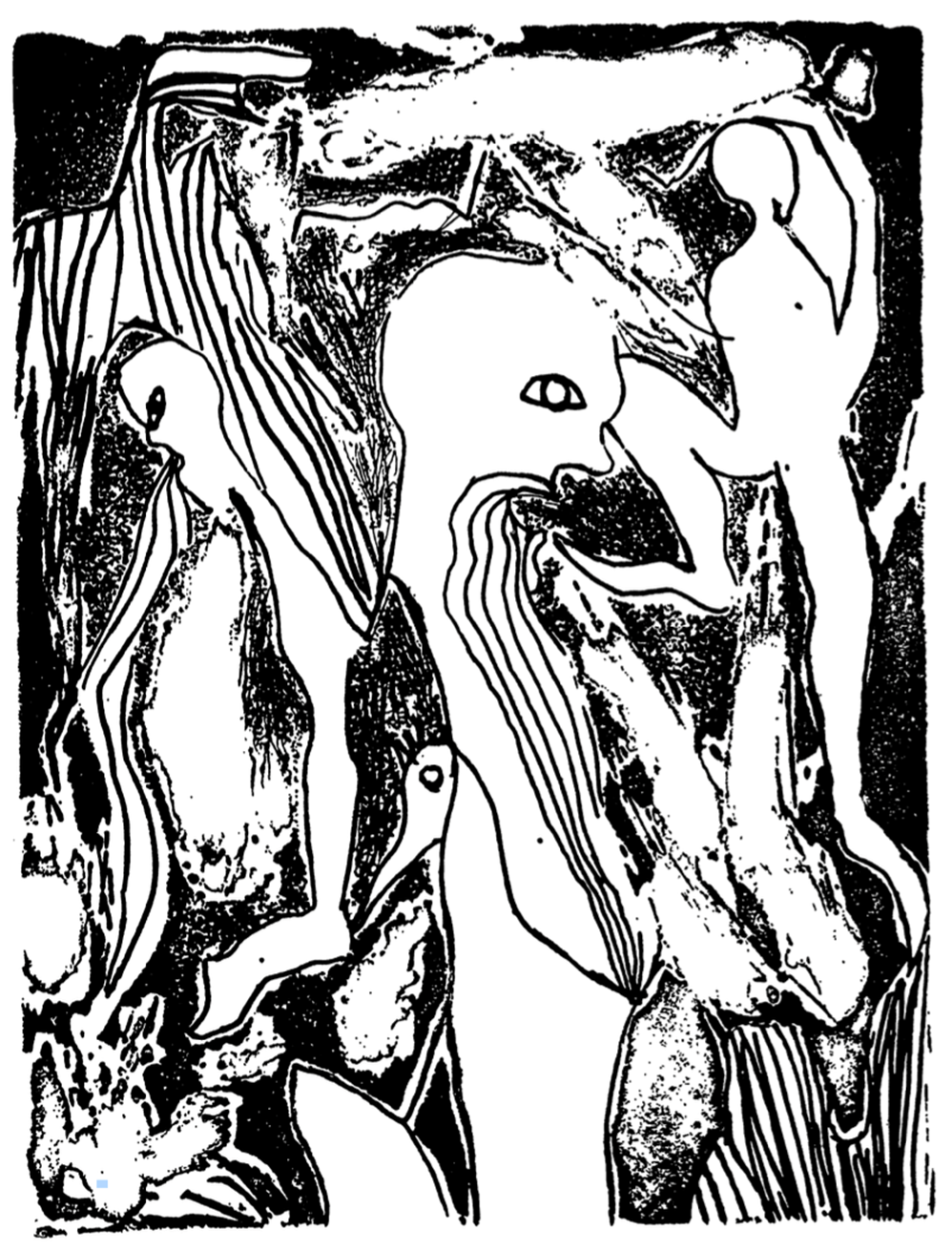
Dorothy Sekkade, Death. 1963. Woodcut.
Christopher Okigbo, in the acknowledgment prefixed to his poem Silences, makes the following observations: “The author wishes to acknowledge his debt to those composers whose themes he has used or varied in certain parts of the present work. The introit is a variation on a theme in Raja Ratnam's At Eight-fifteen in the Morning; the first three passages of the first movement are variations on a theme by Malcolm Cowley; “Sand banks sprinkled with memories” in the fourth passage of the same movement is a variation on Stephane Mallarme's “Au bosquet arrose d'accords'in his L'Apres-midi d'un Faune”; the sixth passage of the same movement is a variation on a theme in Rabindranath Tagore's Stray Birds”.3 Ulli Beier, in his paper read to the Makerere conference discussing the poetry of J. P. Clark, remarks, "John Pepper Clark is a very different poet. His background is similar to that of Okigbo…. He studied English, and what Ezra Pound is to Okigbo, Eliot and Hopkins are to Clark. As in the case of Okigbo, one finds it occasionally disturbing to recognize the “ready-made” language."4
What these examples clearly show is that African literature as now understood and practiced is only a minor appendage in the mainstream of European literature. Both creative writers and literary critics read and devour European literature and critical methods. The new drama of J. P. Clark is seen in terms not only of the classical past of Aristotle and the Greeks, but of the current Tennessee Williams and the Absurdists, leading to such crudities as Una Maclean's comparison of the simple and child-hungry Ebiere to the sexual complications of Big Daddy's American family. In this kind of literary analysis, one just parrots Aristotle and the current cliches of the English and American New Critics.
The consequence of this kind of literature is that it lacks any blood and stamina and has no means of self-enrichment. It is severely limited to those few European-oriented college graduates in the new universities of Africa, steeped as they are in European literature and culture. The overwhelming majority of the local audience, with little or no education in the conventional European manner, has no chance of participating in this kind of literature. Less than one percent of the Nigerian people have the ability to understand Wole Soyinka's Dance of the Forest. Yet this was the play staged to celebrate their national independence, tagged on to the idiom and traditions of a foreign culture. It is no wonder that a poet like Christopher Okigbo so readily resorts to Mallarme's idea of an aristocratic and limited poetic community; his impertinent remark, “I don't read my poetry to non-poets,” is Mallarme in paraphrase.
The purpose of this article is not to discredit these writers, who have achieved much within an extremely difficult and illogical situation. It is to point out that the uncritical acceptance of English and French as the inevitable medium for educated African writing is misdirected and has no chance of advancing African literature and culture. In other words, until these writers and their Western midwives accept the fact that any true African literature must be written in African languages, they are merely pursuing a dead end, which can only lead to sterility, uncreativity, and frustration.
The conference itself, faced with the fundamental question of defining African literature, and the problems involved for an African writing in a language that is not native to him, came very near the truth: "It was generally agreed that it is better for an African writer to think and feel in his own language and then look for an English transliteration approximating the original."5 This conclusion, naive and misguided as it is, expresses the problem concisely and accurately, and it is from that that we shall find a new direction for African literature.
An African writer who thinks and feels in his own language must write in that language. The question of transliteration, whatever that means, is as unwise as it is unacceptable, for the “original” which is spoken of here is the real stuff of literature and the imagination and must not be discarded in favor of a copy, which, as the passage admits, is merely an approximation.
Of course, all the old facile arguments would arise again-the multiplicity of African languages, the limitation of the audience to small patches of tribal groups, questions of orthography, and so on. Yes, but why not? I believe that every language has a right to be developed as literature. There is no part of the world where a false literary unity has been attempted in the way that we are doing today in Africa, not even in Europe. The problem has always been met by the technique of translating outstanding literary achievements into other languages, especially the more widespread and influential languages of the world. One wonders what would have happened to English literature, for instance, if writers like Spenser, Shakespeare, Donne, and Milton had neglected English and written in Latin and Greek simply because these classical languages were the cosmopolitan languages of their times. Even though a man like Milton could write even more easily in Latin and Greek, he did his major works in his own mother tongue without playing to the gallery of international fame.
Literature, after all, is the exploitation of the possibilities of language. It is the African languages that are in crying need of this kind of development, not the overworked French and English. There is, for instance, a good deal of scholarly work being done on the linguistic structure of several African languages, but there is practically no use being made of this work by creative writers, simply because we are all busy fighting over the commonplaces of European literature. If linguistic science devotes so much energy and attention to African languages in spite of their limited scope, why should imaginative literature, which has a greater chance of enriching the people's culture, consider it impossible to adventure in this direction?
The criticism being done today on African writing in English and French sounds so dull, drab, and flippant mainly because there is no opportunity for original thinking. It is the same cliches over and over again-romanticism and classicism, realism, sentimentality, Victorianism, surrealism, and so on. There is no need for creative thinking in order to become a “leading critic or authority” in African literature. Fraser, Freud, Darwin, and Marx are, as in European literature, the necessary reading for the acquisition of fundamental critical tools.
What I am advocating here is not easy, for it entails a good deal of hard work and hard thinking, and what is more, a necessary casting overboard of hardened debris of the overblown ego. It would force some “leading” critics to go in for the hard school of African linguistic studies, a knowledge of some of the important African languages, before generalizing and formulating all kinds of philosophical and literary theories. Literature in Africa would then become the serious business that all literature truly is, reaching out to the people for whom it is meant and creating a true culture of the African peoples that would not rely on slogans and propaganda, nor on patronage of doubtful intentions.
The basic distinction between French and German literature, for instance, is that one is written in French, and the other in German. All the other distinctions, whatever they be, are based on this fundamental fact. What therefore is now described as African literature in English and French is a clear contradiction, as false a proposition as “Italian literature in Hausa” would be.
What one would like future conferences on African literature to devote time to is the all-important problem of African writing in African languages, and its implications for the development of a truly African sensibility. In fact, the secondary place which African languages now occupy in our educational system would be reversed if our writers would devote their tremendous gifts and abilities to their own languages. Attempts have recently been made to include the study of African languages in the curriculum of some of the new African universities. This program would certainly have no future, for all that is available even at the university level is the usual string of proverbs, a few short stories on the tortoise and the tiger, and a number of inadequate grammar books written by untrained linguists. The student of Yoruba, for instance, has no play available to him in that language, for Wole Soyinka, the most gifted Nigerian playwright at the moment, does not consider Yoruba suitable for The Lion and the Jewel or The Dance of the Forest.
The main reason for the study of a language is that it contains great literature—or some form of literature. This was what led scholars like Eliot and Pound to the study of oriental languages in their poetic experiments early in this century. There is little doubt that African languages will face inevitable extinction if they do not embody some kind of intelligent literature. The best way to hasten this extinction is by continuing in our present illusion that we can produce African literature in English and French.
The last junketing at Makerere was good as far as it went, but it is a little scandalous to admit that its only concrete achievement is that it gave African writers and their patrons the opportunity to get to know one another!
Notes
1 Ezekiel Mphahlele, Press Report, Conference of African Writers of English Expression, MAK/V(2), Makerere, 1962.
2 Una Maclean, "Song of a Goat," Ibadan, (October I962), p. 28.
3 Christopher Okigbo, "Silences," Transition 8 (March i963), p. I3.
4 Ulli Beier, "Contemporary African Poetry in English," Conference of African Writers
Report, MAK/ I I (4), Makerere, 1962
5 Ezekiel Mphahlele, Press Report, Conference of African Writers of English Expression MAK/V(2), Makerere, I962.
Source
Obiajunwa Wali. The Dead End of African Literature,Transition, 1997, № 75/76, с. 330–335