

-
Age45 години
-
SexFemale
-
EthnicityEthnicity: twenty years ago, I considered myself to have a Russian identity. At present I see myself as a naturalized Bulgarian, but in essence I have always been and remain a cosmopolitan
-
Religionbaptized in Eastern Orthodoxy, with an agnostic stance
-
Level of educationhigher
-
Family status (children included)married, son
-
Place of birth (town, state)Place of birth: Primorsk, Ukrainian Soviet Socialist Republic, Zaporizhzhia Oblast, Tavria steppe, the town of Primorsk, but I grew up in the village of Inzovo, which at that time was predominantly Bulgarian-populated
-
Now living in (town, state)Buhovo (Sofia), Bulgaria
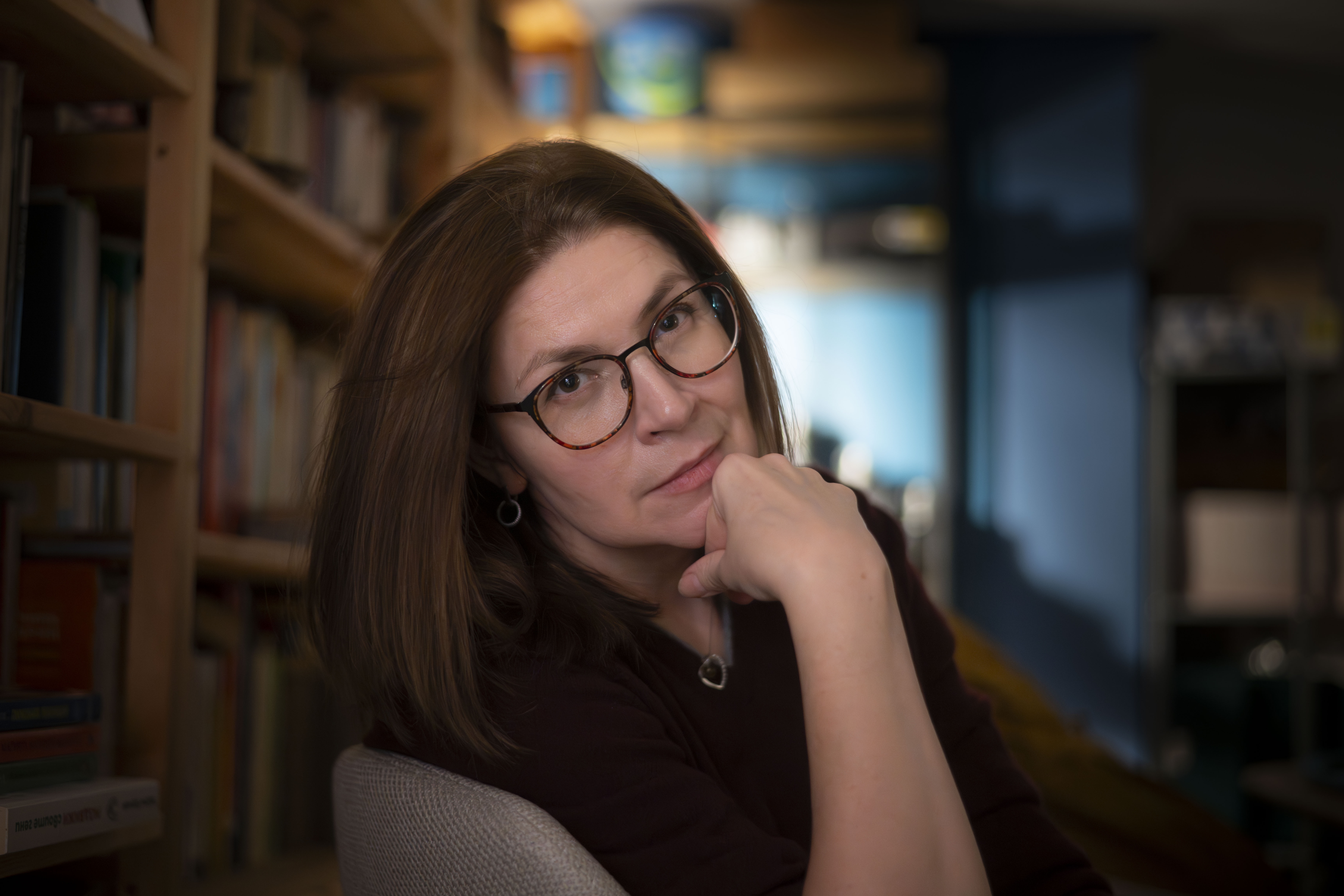
1. A human being, female, mother, aesthete, humanist, and misanthrope together.
2. Being a mother is definitely the most important thing to me. Next comes “wife.” Here, the professional identity also matters. Because of the paradox of humanist/misanthrope, I feel a certain inner conflict and often become emotional: I love the human being by definition, but I do not recognize part of those around me as “my own.” I believe in human potential, but the moral problems and failures of our species are deeply disappointing. The idealist in me strives to uphold honesty and compassion. Gender identity is a given, and above, I merely state it as a fact, but I do not consider it defining. I unquestionably believe in equality among people, regardless of their sex, but I am aware that we are all born with different endowments and even burdens. I do not understand religious and national identities. I do not reject them in others if those others insist on them, but for me personally, they are superfluous. My husband self-identifies as Bulgarian, but I do not perceive him as such. To me, he is a wonderful Human Being. I grew up in a family with a Russian-speaking mother, surrounded by Bulgarians, in Ukraine, and that was before the collapse of the USSR. I speak and work fluently in all three languages—Bulgarian, Ukrainian, and Russian. All three cultures are equally present in me; I recognize parts of each within myself, both the good and the bad, but none of them predominates. One could say I do not have a specific national identity. This is said in brief because if I continue, I would have to mention that my dear grandmother is Bulgarian, one of my grandfathers was repressed in Kazakhstan, a Ural Cossack from Baikal, my great-grandmother is from the noble Biryukov family, and my great-grandfather, according to my mother, is a “baptized” Jew, a graduate of a theological seminary, etc.
3. With the years and with the arrival of our son, the arrangement has altered.
I noticed these changes mostly in moments of inner conflict. But the rearrangement, though natural, always happens through some kind of refracting, which does not have to be rough. National identity gradually fell away, probably because I had already been living in Bulgaria for quite some time and began to identify somewhat with Bulgarians; until 2005, I said “at your place” and “at our place,” and from then on, this explicit distinction gradually faded. Apparently, by then I had already lost the outsider’s distance. The longer a person lives in another culture, the more they “merge” with it. Psychologically, this led me to a change in loyalty to the “old homeland.” Russia, as it is today, has lost me. However, these experiences will never change my love for Russian authors. I think what matters more is what a person says, not what language they speak.
3. I left the village and the country I grew up in at just 17. From that moment, I began handling challenges on my own. I learned Bulgarian quite quickly, but I still came here without a language. Completely without a language. Moving could not but have changed me. Until I finished my bachelor’s degree, I still didn’t know Bulgarians outside the circle of my classmates and friends from Sofia University. Since the journalism profession requires familiarity with different social milieus, I decided to work as a waitress for empirical purposes. I had the opportunity to start work in a Bulgarian media outlet, but I sensed that I lacked the necessary (deep) knowledge of Bulgarian society and worried that this ignorance might be exploited in a professional environment I found not especially high-minded. This experience also transformed my attitude toward reality and the world. I never consciously sought out a social environment for myself—it found me. But I still think literature has always come first. It is what has built and transformed my identity. At the foundation of my worldview there have always stood Ukrainian, Bulgarian, and Russian authors. While some taught me to see the boundless depth and tragedy of the human being, others gave me eyes for the melancholy and absurdity of our everyday life.
4. I identify with every single image from the books or films I read and watch, but let’s say Yovkov ’s Rada and Don Quixote. Though I consider my answer somewhat rhetorical. I am an empathetic reader and viewer; only I find sharing specific images with the world too intimate. I try to get under the skin of every character, regardless of their era, character, or geography. One could say my multicultural background helps with this. I believe it also helps in my work as a translator.
The songs we choose to listen to become part of our self-concept. At different ages, I listened to different music, and this “musical map” serves as my personal history and my different identities over the course of life. As an infant of a few months, my father soothed me with Pink Floyd, and at 10, I was shaken forever by David Bowie. My teenage years passed with punk rock, hard rock, and metal, while at the same time, I was part of a trio performing folk songs. Now I listen to various strains of jazz, classical music (mostly organ), a few punk and rock bands from earlier, and folk songs. I see a very clear link between my musical preferences and my identity. My grandmother’s people come from the Yambol region, and though she was born in Tavria, she sang Thracian songs. There’s no way I wouldn’t love them. I lulled our son to sleep with Russian and Ukrainian songs.
5. No, I haven’t noticed such a crossover into real life, or perhaps I simply can’t think of examples.
6. Being a mother and a wife is pure joy for me. It’s different, however, with my other identities—sometimes they help, and sometimes they hinder. People who like to label often even feel uneasy around me and for me, because they can’t fit my lack of national identity into their neatly arranged notions of nations and national psychologies, or they quickly slot me into a stereotype that suits them. Those more open to new things become curious. The fact that I’m an agnostic hinders me more than it helps.
7. A multitude of amusing stories follow from this “atypicality,” which I tell our son, and through them, we try to create an environment where we can freely discuss different cultures and their strengths and weaknesses, with none of these cultures being privileged. All this develops the ability to understand “the other” without perceiving them as a threat. Carrying several cultures at once gives me a sense of freedom and adaptability—I hope Kamen will feel that too.
8. Moving to Bulgaria allowed me to take a more critical stance toward my other cultures and their values. I study the customs and language of the people around me—relatives, neighbors, new friends. The Shopi villages are exceptionally colorful and rich in customs, traditions, and language, and have a very clearly defined identity even within individual hamlets. My daily curiosity about my current environment is genuine; I’m even starting to wonder whether to take up dialectology and sociolinguistics seriously. It’s interesting for me to observe all this, but my identity hasn’t changed from living here, even though I manage quite well to “disguise” myself, even in my speech. My husband’s kin comes from Kyustendil, Shopluk, and Vratsa! You certainly understand what I mean, don’t you?
9. I ’ve lived in Bulgaria for 27 years; I speak Bulgarian better than a large part of Bulgarians; my husband is Bulgarian. My mother identifies as Russian, my father—more likely as Bulgarian, though his father was Russian; my first language is Russian. I was born in the Ukrainian SSR; I studied Ukrainian from 2nd through 11th grade; I make first-rate Ukrainian borscht, which my Bulgarian family, including my Shop father-in-law, adores; and in this vile war, I am absolutely on Ukraine’s side. I love Bulgarian, Russian, and Ukrainian literature equally—this is not a lack of principle, but a very strong principled stance that I stand behind. I like intercultural hybridity and believe that it is precisely what can save the world.